Witstep — A Playful Puzzle Journey
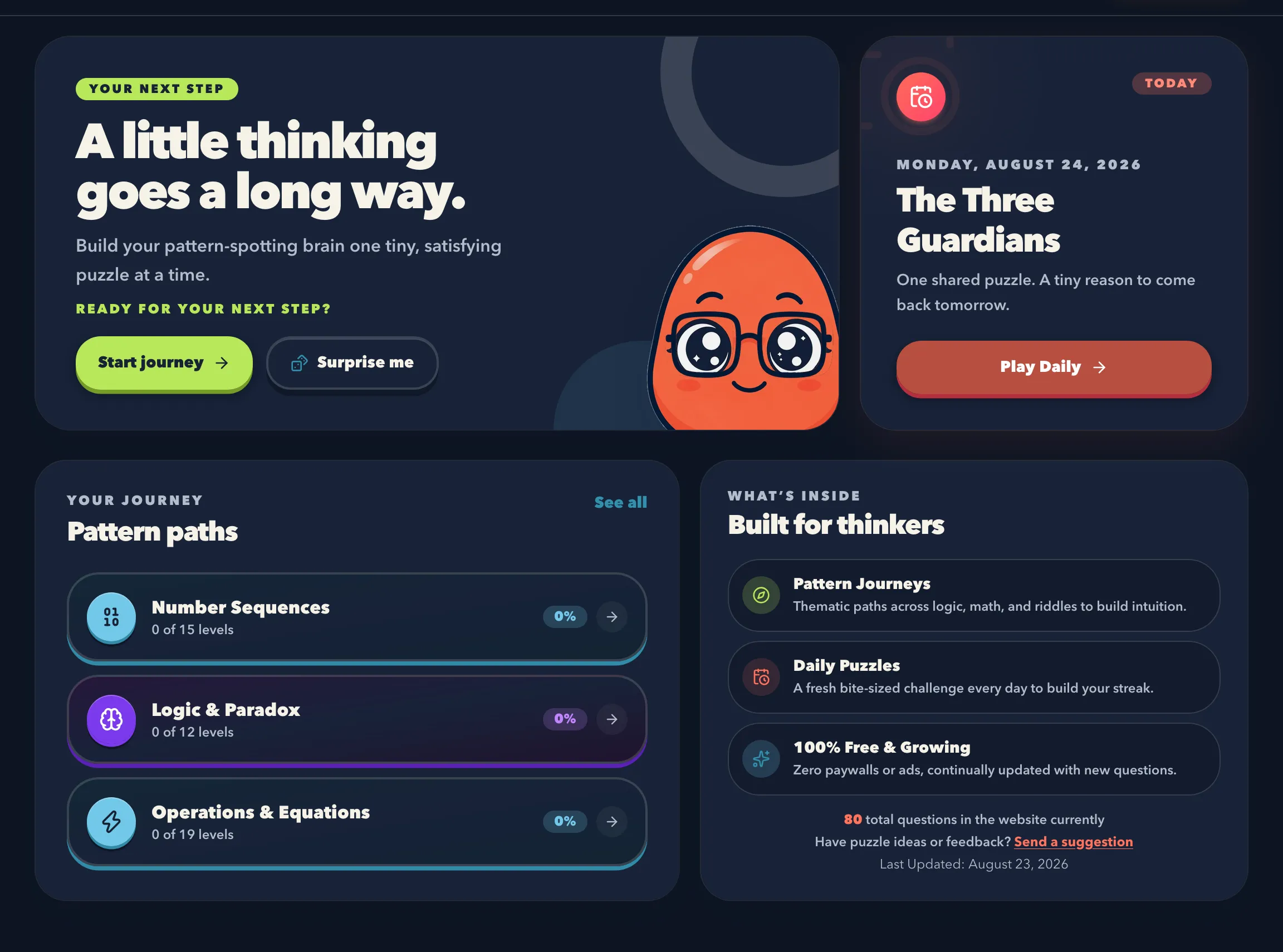
Witstep is a free collection of bite-sized logic and math puzzles designed to make a few minutes of focused thinking feel inviting. I wanted the experience to sit somewhere between a daily ritual and a small adventure: approachable enough to open on a break, but structured enough to reward coming back.
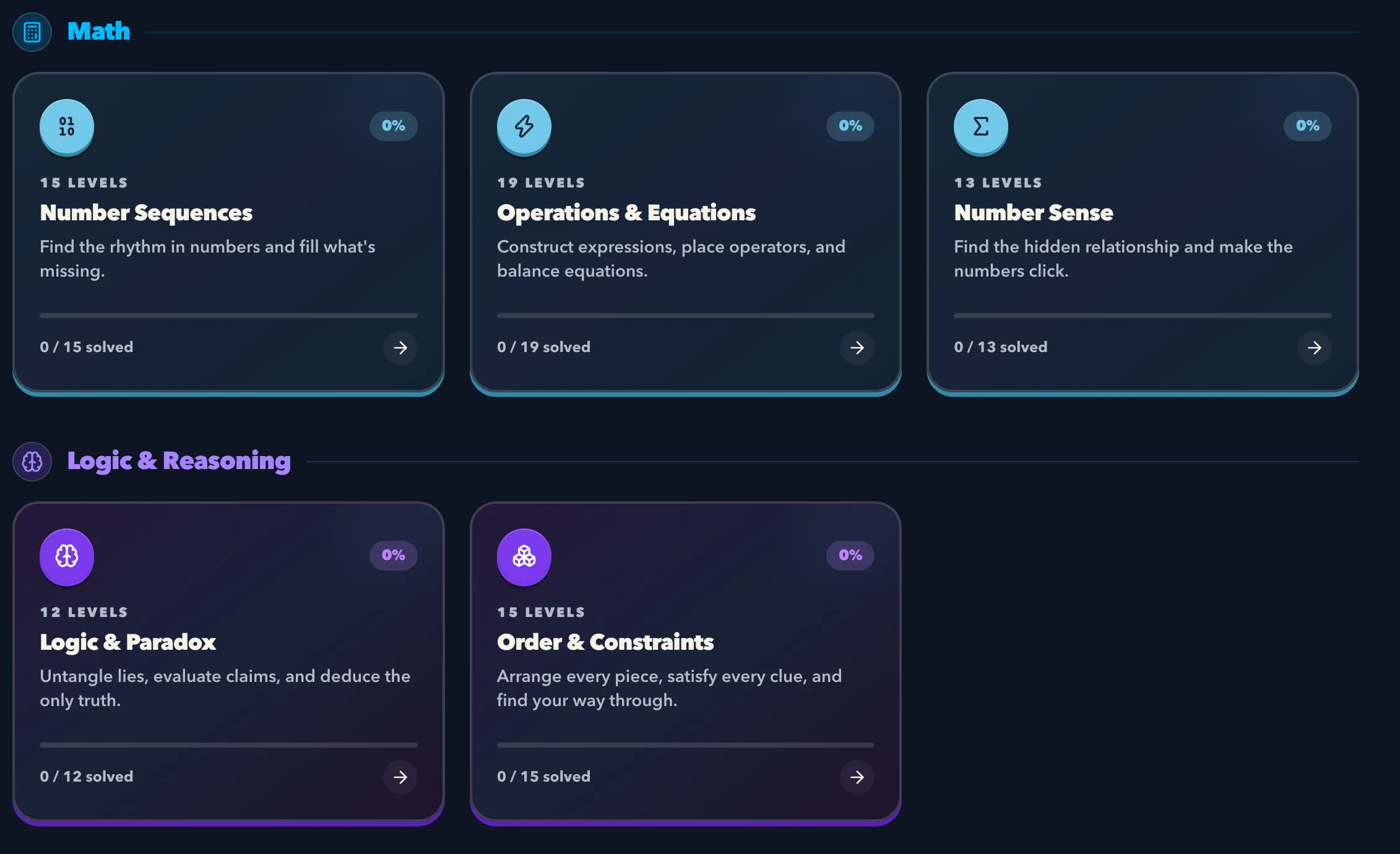
The product has two complementary paths. Daily offers one fresh challenge and keeps a lightweight streak, while Journey lets players explore themed collections at their own pace—from number sequences and equations to logic riddles, constraint puzzles, visual number sense, and matchstick challenges.
One player, many kinds of puzzle
The central technical challenge was supporting very different interactions without rebuilding the surrounding experience each time. Witstep uses typed puzzle definitions and a renderer registry to connect each puzzle kind to its own interface. A shared player coordinates selection, validation, hints, feedback, explanations, completion, and navigation.
This keeps the experience consistent for players while allowing each puzzle to behave naturally. A sequence can use fillable slots, an equation can evaluate a completed expression, and an arrangement puzzle can offer direct manipulation—all inside the same lifecycle. Adding a new puzzle type is mostly a matter of defining its data contract, evaluator, and renderer rather than creating another standalone page.
Making puzzle content trustworthy
Constraint puzzles are deceptively difficult to author: a clue can be invalid, redundant, or accidentally allow several answers. I built the rules as structured data and paired the runtime evaluator with a small solver and validation tool.
The tool enumerates candidate arrangements, reports how many solutions exist, catches malformed rules, and warns when removing a clue does not change the solution set. That turns content quality into something testable, not just something checked by hand, and lets the puzzle library grow with much more confidence.
Progress without account friction
Witstep deliberately starts without sign-up. Journey completion and daily streaks are stored locally with a versioned Zustand store, so a player can begin immediately and return where they left off. Repository boundaries keep puzzle content and progress storage separate from the UI, leaving a clear route to a remote backend later without coupling the current experience to one.
The interface adds the details that make a small game feel considered: tactile controls, drag-and-drop interactions, progressive hints, clear solve states, sound feedback, a responsive layout, light and dark themes, and a friendly mascot that acts as a guide rather than decoration.
Built with
Witstep is built with Next.js 16, React 19, TypeScript, Tailwind CSS, shadcn/ui, Zustand, and dnd-kit. The puzzle engine, progress rules, renderers, and core interactions are covered by a Vitest and Testing Library test suite.
The result is a compact product with a deliberately extensible core: easy to start playing, pleasant to revisit, and ready to support new puzzle formats as the journey expands.